A First-Time Visitor’s Checklist for Reading a Casino Setting
A first-time visitor’s checklist for reading a casino setting helps you notice entrances, signs, seating, sound, and public spaces without focusing on play.
A first-time visitor’s checklist for reading a casino setting begins before you reach the gaming floor: notice how the entrance directs you, what signs make legible, and where a non-gambling visitor can pause. In Bắc Ninh or elsewhere in Vietnam, a casino is not simply a room of games; it is also a designed public environment, shaped by its location, audience, rules, and surrounding hospitality spaces.
This checklist is for observation, not participation. It helps you decide what to look at according to your situation: arriving with a companion, visiting mainly to understand the architecture, seeking a quiet place to wait, or trying to make sense of a space that feels unfamiliar. If an area is restricted or photography is prohibited, follow posted rules and staff directions.
What kind of visit are you making?
Start by choosing the question that brought you inside. A visitor interested in design will watch how the building guides movement; someone accompanying a friend may care more about meeting points and comfortable public seating. Neither requires close attention to games.
- If you are studying the setting: Look for thresholds, sightlines, materials, and the transition between public and restricted areas.
- If you are waiting for someone: Find a clearly public seating area, note its nearest landmark, and agree on a meeting point.
- If you are visiting with family or a group: Check the venue’s age-access rules and identify spaces everyone in your party may enter.
- If you feel disoriented: Step back to a public corridor or lobby, use a directory, and ask staff for directions rather than following unfamiliar signs into a restricted area.
These situations can overlap. The useful distinction is whether you want to interpret the design, coordinate with other people, or simply move through the building comfortably.
How does the entrance set expectations?
Look at the approach before you look inside. Is the entrance easy to identify from the street or hotel lobby? Does it share a threshold with a restaurant, shopping area, or other venue, or does it have a distinct arrival point? These details suggest how the casino relates to its larger setting without telling you anything about what happens at a particular game.
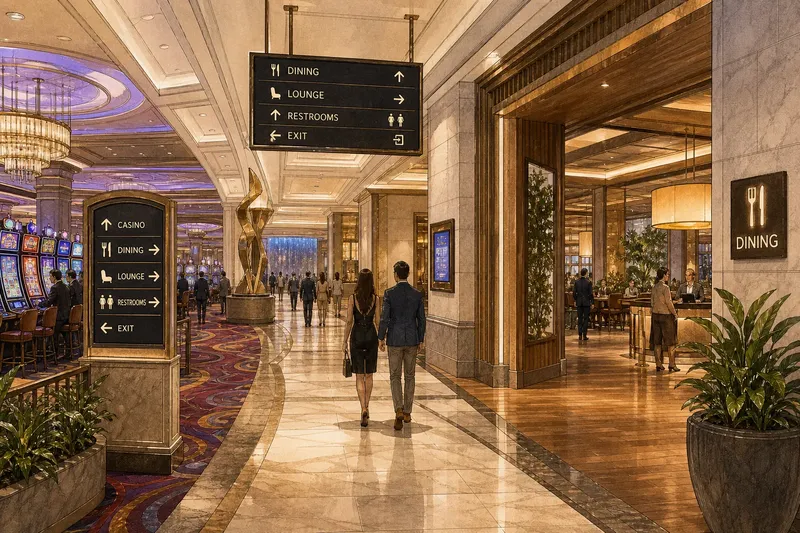
Notice the first transition: a change in flooring, lighting, ceiling height, or sound can signal that you have crossed into a different environment. A reception desk, security point, or prominent directory may establish where visitors should pause and what spaces are open to them. Treat these as cues to orientation, not invitations to enter every visible area.
Imagine you arrive with a friend who wants to meet after looking around separately. You notice that the lobby opens onto two corridors and agree to meet beside a clearly named public café rather than at an indistinct doorway. The expected result is a shared landmark that is easier to describe and find again.
Which signs help you read the building?
Signs do more than label rooms. They reveal the venue’s priorities: which destinations receive the clearest directions, which languages appear, and whether public amenities are easy to distinguish from gaming or staff-only areas.
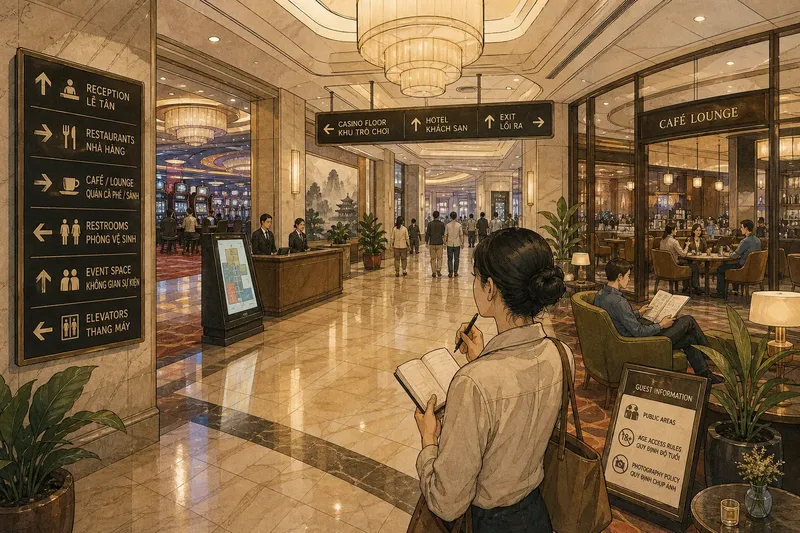
Follow one sign at a time and compare it with the space it names. A directory may list restaurants, restrooms, elevators, or event rooms; smaller signs may clarify access or point toward an exit. If a sign uses unfamiliar terminology or languages, look for a second cue, such as a floor map or staffed information desk, rather than guessing.
For a visitor interested in language and culture, wording itself is worth noticing. English, Vietnamese, and other languages may appear in different combinations, sizes, or locations. Record the wording only where note-taking is permitted, and avoid photographing people or controlled areas.
Where can you sit without joining the activity?
Seating tells you which parts of a venue are designed for pausing and which are primarily routes through the building. Public benches, lobby chairs, and restaurant waiting areas can offer a place to rest or wait; seats near active gaming areas may be intended for people participating in those activities. Read the setting and any posted access rules before settling in.
Compare a few practical details:
- Visibility: Can you see a directory, entrance, or agreed meeting landmark from the seat?
- Traffic: Is the area beside a busy passage, or set slightly apart from moving crowds?
- Purpose: Does the space appear to belong to a café, event lounge, lobby, or restricted area?
- Comfort: Is there room for a companion or mobility aid without blocking a route?
- Access: Do signs or staff indicate that the area is open to visitors who are not using gaming facilities?
Choose the clearest public option for your situation. If you cannot tell whether a seat is available to you, ask a staff member instead of treating an empty chair as permission.
What does the sound tell you?
Listen for layers rather than trying to identify every source. You may hear conversation, announcements, music, service activity, or sounds from gaming areas. Their relative prominence can make a corridor feel busy, a lounge feel calm, or a transition between spaces feel abrupt.
Notice where the sound changes. Does the lobby soften the noise from a larger room? Does a restaurant have its own acoustic character? Are announcements easy to hear in public areas? These observations help explain how the venue separates functions and manages attention, without requiring you to approach a game or record conversations.
If you are sensitive to noise, treat sound as a practical sign of whether a public area suits you. Move to a quieter permitted space if one is available, and use the venue’s posted information or ask staff where visitors may wait. Avoid assuming that a quiet-looking doorway leads to a public room.
How do public areas differ from restricted spaces?
A casino may connect to a hotel, restaurant, event venue, or shopping area, but connected spaces do not necessarily share the same access rules. Look for clear boundaries: reception points, access notices, doors marked for staff, or signs stating who may enter. The distinction matters especially when a building combines leisure and gaming under one roof.
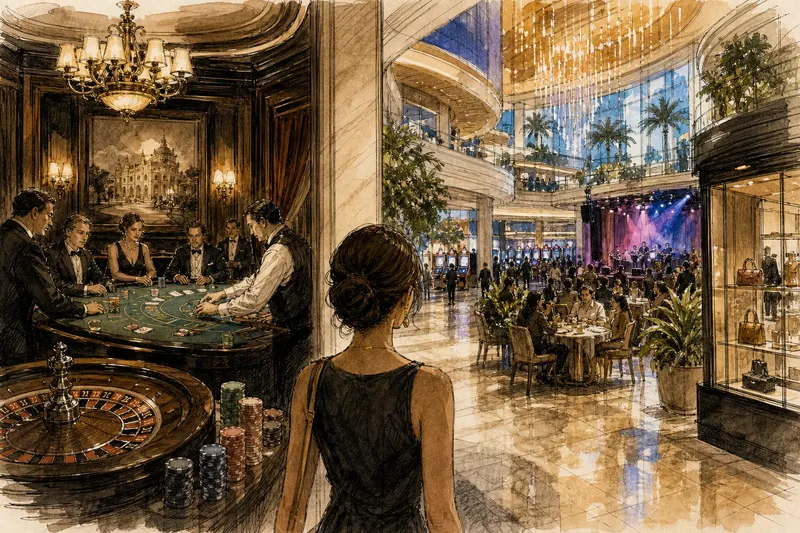
For a cultural reading, observe how public areas offer alternatives to the gaming floor. A lobby may emphasize arrival and meeting; a restaurant may orient visitors around food and conversation; an event space may bring people together for a scheduled occasion. The presence and prominence of these areas can shape how the venue presents itself to visitors.
Do not infer that every public-looking passage is open to everyone. Where access depends on the venue’s rules, posted information and staff guidance are the relevant sources; local requirements may also apply.
What should a first-time visitor check?
- Entrance: Identify the main public arrival point and note whether it is shared with another venue.
- Directory: Find a map or information desk before choosing a route.
- Signs: Check which languages are used and whether public amenities are distinguished from restricted areas.
- Meeting point: Select a named, visible landmark that your companion can locate independently.
- Seating: Confirm that a waiting area is public and does not obstruct circulation.
- Sound: Notice where the environment becomes louder or quieter, especially if you need a calmer place to pause.
- Boundaries: Look for access notices and respect staff-only or otherwise restricted spaces.
- Exit: Note a clearly marked public exit so you can leave without retracing an uncertain route.
Use the list to answer a simple decision: can you orient yourself and remain in spaces clearly intended for visitors? If yes, continue observing at your own pace. If not, return to a staffed public point and ask for help.
What do first-time visitors often ask?
Can I visit without gambling?
That depends on the venue’s access rules and the laws that apply to it. Check official information or ask staff which public areas are open to visitors who are not gambling.
What should I notice first in a casino setting?
Begin with the entrance, directory, and public boundaries. Those features help you understand where you are and which parts of the building are intended for visitors.
Can I take photographs or make notes?
Follow posted restrictions and staff instructions, particularly around gaming areas and other controlled spaces. If photography is not allowed or you are unsure, rely on brief written notes only where note-taking is permitted.
Where should I wait for a companion?
Choose a named public landmark, such as an information desk or a permitted café area, and confirm the meeting point together. Avoid relying on a room entrance or corridor that may be difficult to distinguish from nearby spaces.
How can you leave with a clearer impression?
Before leaving, take a moment in a public area to recall the route between the entrance, a directory, your chosen seating, and the exit. That small mental map can tell you whether the venue is easy to read, which spaces feel distinct, and where signs or boundaries could be clearer.
A first-time visitor’s checklist for reading a casino setting is most useful when it keeps attention on the environment rather than the games. Entrance, signs, seating, sound, and public areas each offer a different clue about how the place welcomes, directs, and accommodates people; together, they make a visit more observant without turning it into participation.